+30 2810 237502 ▾



Water-Cooled ER20 Spindles for CNC Routers 3-13mm Price range: 330,00 € through 380,00 € (inc VAT)
Switching Power Supplies for CNC Stepper Drivers — 24V, 36V, 48V Price range: 25,00 € through 57,00 € (inc VAT)
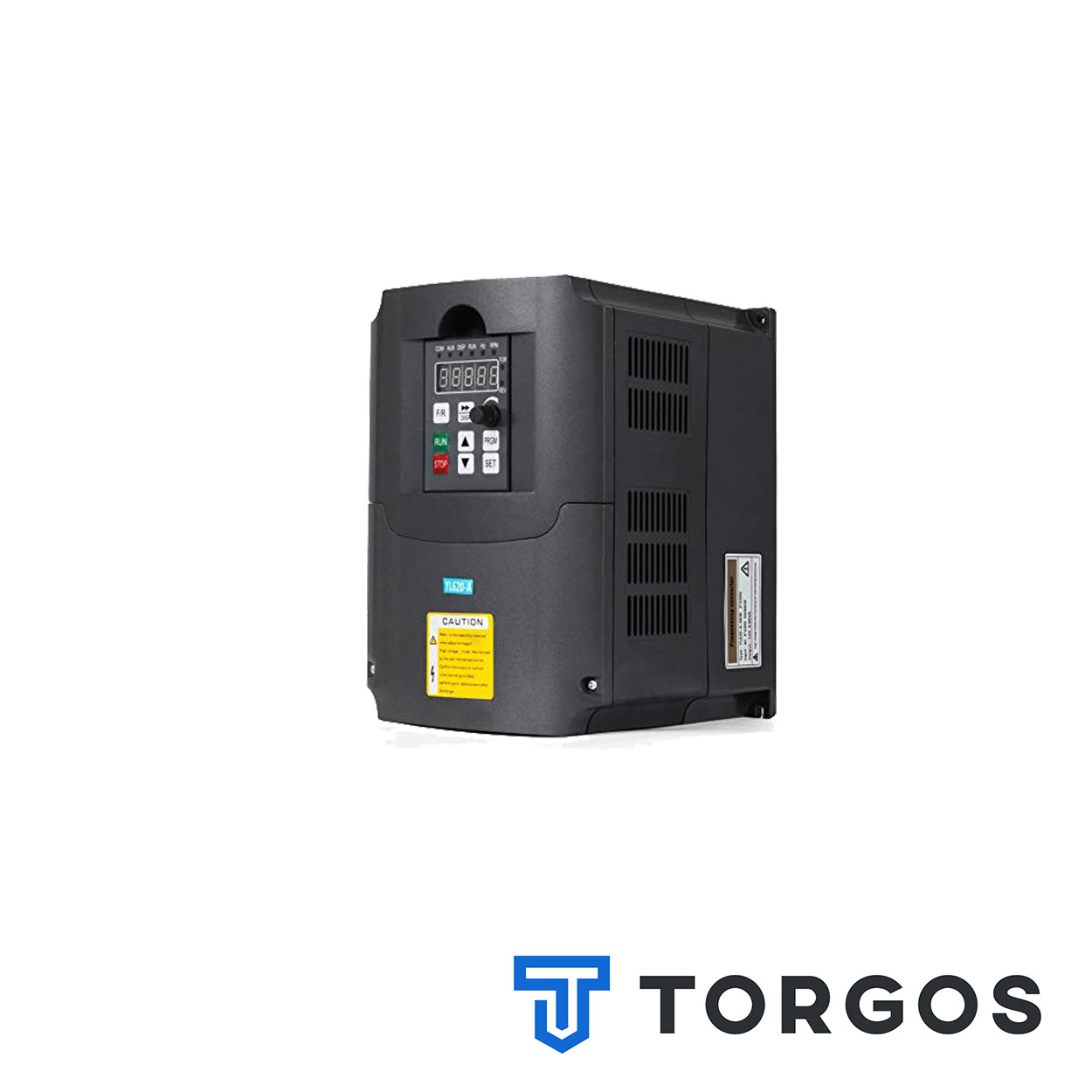
Spindle VFD Inverter with 0-10V Speed Control
Price range: 275,00 € through 280,00 € (inc VAT)
This spindle VFD inverter regulates CNC spindle speed by converting the incoming mains frequency into a variable frequency output. It accepts a 0–10V control signal from the CNC controller for automatic speed changes during a program, or can be set manually from its own panel. Suited to router and milling machine builds where steady, adjustable spindle speed is required.
Περιγραφή
A spindle VFD inverter is the control unit that sets the rotational speed of a CNC spindle motor. It converts the fixed frequency of the mains supply into a variable frequency output, so the motor turns at whatever speed a job requires. It suits machine builders and workshop operators who build or maintain CNC routers and milling machines.
Without a matched inverter, a spindle motor cannot start smoothly or hold a steady speed once the cutting load changes, such as when the router meets denser material. The VFD gives the operator that control, either from the buttons on its own panel or automatically through a signal sent by the CNC controller while a program runs.
Features
A spindle VFD inverter’s core job is turning alternating current into a variable frequency, which sets the motor’s speed. Because the frequency ramps up gradually rather than switching the motor to full speed instantly, the belts and bearings take less mechanical shock at start-up.
The same principle keeps the spindle steady once cutting starts, since the inverter compensates as load increases so the output frequency, and therefore the RPM, stays close to the set value instead of dropping as the material pushes back.
- Adjustable output frequency that directly sets spindle rotation speed
- 0–10V control input for direct commands from the CNC controller
- Overload and overheating protection for the drive and the motor
- Digital keypad and display for parameters and running values
- Smooth acceleration and deceleration ramps for gentler starts under load
Where this spindle VFD inverter is used
A spindle VFD inverter belongs on any CNC router or milling machine where the spindle needs a controllable speed rather than a single fixed value. It is standard in DIY and small-workshop builds, and is also fitted as a replacement when a factory drive fails.
Typical jobs include wood and MDF routing, plastic and acrylic engraving, and light aluminium milling, where the ideal spindle speed depends on the material and tool diameter. Anyone sourcing spare electronics or building a new CNC gantry can browse the full range at the CNC parts shop.
What to check before buying
When choosing a spindle VFD inverter, match its rated power and voltage to the spindle motor it will drive, since an undersized unit trips under load. Check the motor’s rated current on its nameplate against the inverter’s continuous output current, since the two figures can mismatch on single-phase to three-phase conversions.
Confirm the control method the CNC controller expects, since most breakout boards send a 0–10V analogue signal, while some use 0–5V or PWM instead. Also check the drive’s supply voltage against the workshop mains, since 220V single-phase and 380V three-phase units are not interchangeable.
Installation and maintenance
Mounting a spindle VFD inverter in a ventilated enclosure, away from dust and coolant spray, extends its working life, since VFDs generate heat under load. Keep the motor cable separated from control and signal wiring where possible, since switching noise can otherwise disturb the 0–10V line and cause erratic spindle speed.
Routine care is mostly about keeping the cooling fan and heatsink free of dust, since a clogged unit overheats and trips before any part actually fails. For background on how the frequency conversion works, the variable-frequency drive principle explains the electronics common to every VFD.
FAQ
Can this inverter run a single-phase spindle motor? Most VFDs used on CNC machines accept single-phase input and produce three-phase output for the motor, but this varies by model, so check the phase count before wiring it in.
Does this spindle VFD inverter need a signal from the CNC controller to run? No, it can run at a fixed frequency from its own panel, though most CNC setups use the 0–10V input so a running program can change spindle speed automatically.
What causes a VFD to trip during a cut? A trip usually points to an overload from too aggressive a pass, a wrong current setting, or a cooling problem inside the drive, all worth checking first.
Επιπλέον Πληροφορίες
| kilowatt Power (kW) | 2.2Kw, 3Kw, 4Kw |
|---|
Reviews (0)
Shipping & Delivery


Αποστολή & Παράδοση
Όλες οι παραγγελίες αποστέλλονται με ACS Courier και παραδίδονται σε 1-3 εργάσιμες ημέρες.
Κόστος αποστολής:
- Αποστολή: €5,80
- Αντικαταβολή: €5,50
- Δωρεάν αποστολή για παραγγελίες άνω των €100
Ογκώδη δέματα:
Για ογκώδη ή βαριά δέματα η αποστολή πραγματοποιείται μέσω μεταφορικής εταιρείας με χρέωση στον παραλήπτη.
Αποστολές εκτός Ελλάδας:
Πραγματοποιούνται κατόπιν συνεννόησης. Επικοινωνήστε μαζί μας για περισσότερες πληροφορίες.



Reviews
There are no reviews yet.