+30 2810 237502 ▾


Mach3 USB Motion Controller 100kHz for CNC Machines 46,00 € (inc VAT)

3-Axis Jog Pendant Controller for CNC Router Setup 23,00 € (inc VAT)
LM2596 Step-Down Converter with Adjustable Output
7,00 € (inc VAT)
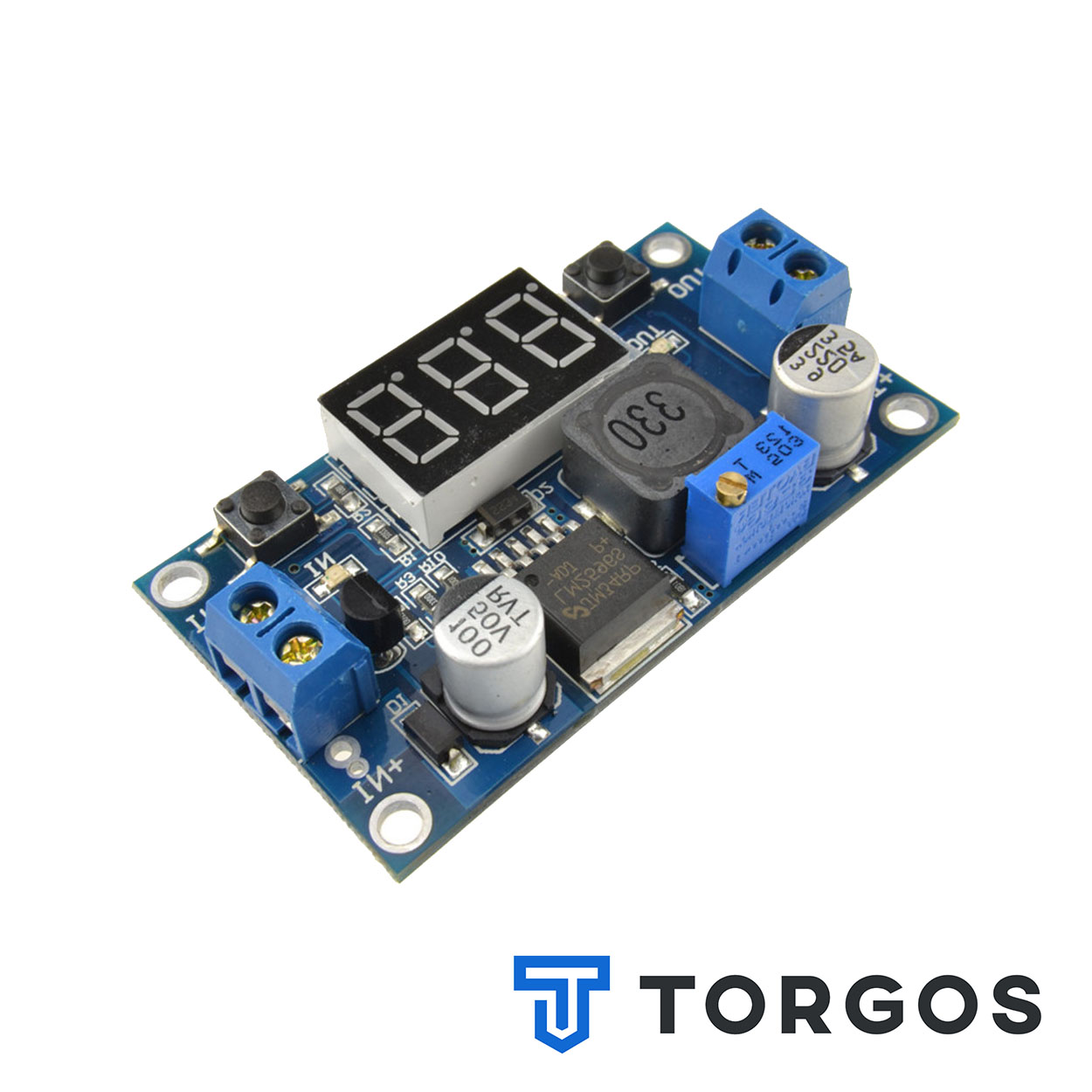
The LM2596 step-down converter is a compact buck regulator module for lowering a higher DC voltage to a stable, adjustable output. It is widely used in CNC control panels, 3D printers, and general electronics to power fans, sensors, and logic boards from a shared supply.
Περιγραφή
The LM2596 step-down converter is a small buck regulator module built around the LM2596 switching IC. It takes a higher DC input and reduces it to a lower, adjustable output, making it a common building block in CNC control panels and general electronics projects.
Anyone wiring a control cabinet who needs 24V dropped to 12V or 5V for fans, sensors, or logic boards will meet this module eventually. The LM2596 step-down converter is popular because it is inexpensive, compact, and needs no design work beyond turning a trimmer and checking the output with a multimeter.
LM2596 Step-Down Converter Features
The board is built around the LM2596 switching regulator, rated for input voltages roughly between 4V and 40V DC. Output is continuously adjustable, typically from about 1.25V up to near the input voltage, set with the small trimmer potentiometer mounted on the PCB. Because the regulator switches rather than dissipating the voltage difference as heat, it stays cool even when dropping a large voltage gap at moderate current.
Layout keeps the inductor, diode, and capacitors close to the regulator to limit switching noise. Most boards use screw terminals or pin headers, so wiring in and out of an enclosure does not require soldering directly to the module.
- Input voltage range roughly 4V to 40V DC
- Adjustable output voltage via onboard trimmer
- Switching (buck) topology for higher efficiency than linear regulators
- Compact PCB footprint suited to control panel enclosures
- Screw terminal or header connections for quick wiring
Where It’s Used
Inside CNC controllers, the LM2596 step-down converter typically feeds cooling fans, limit-switch logic, relays, or small displays from a shared 24V supply, avoiding a second dedicated power supply. It is just as common in 3D printers, stepping bus voltage down to 5V for boards or sensors that cannot take the higher rail.
Hobby electronics, robotics, and automotive projects use the same module whenever a circuit needs a lower, stable voltage from a battery or higher supply rail. Builders sourcing parts for a CNC control cabinet can browse related power supply components in the torgoscnc.gr shop.
What to Check Before Buying
Before fitting an LM2596 step-down converter, confirm the maximum input voltage of the specific board against the supply it will connect to, since ratings vary between batches. Check the current the load actually draws too — these modules are commonly rated around 2A to 3A continuous, and running near that limit without airflow can make the regulator throttle or overheat.
A frequent mistake is leaving the trimmer at its factory setting and assuming the output matches what is needed; measure it with a multimeter under no load, then again once the load is connected. Reverse polarity on the input will damage the board, so check wiring against the silkscreen markings first.
Installation and Maintenance
Installation is straightforward: connect the input observing polarity, set the output with the trimmer while measuring with a multimeter, then connect the load. The LM2596 step-down converter uses a buck switching principle, explained in more detail in the Wikipedia entry on buck converters, useful background for anyone new to switching regulation.
Little maintenance is needed once the voltage is set, but it is worth rechecking the trimmer in high-vibration environments such as a CNC gantry, since vibration can shift it over time. Keeping the module clear of metal shavings and dust, with some airflow, extends its working life.
FAQ
What is the maximum input voltage? Most boards accept up to around 40V DC, but check the rating printed on the specific unit first.
How is the output voltage set? Turn the onboard trimmer while measuring the output with a multimeter, ideally under the actual load.
Is it suitable for powering motors? No — it is meant for low-current logic and control circuits, not motor drives.
Reviews (0)
Shipping & Delivery


Αποστολή & Παράδοση
Όλες οι παραγγελίες αποστέλλονται με ACS Courier και παραδίδονται σε 1-3 εργάσιμες ημέρες.
Κόστος αποστολής:
- Αποστολή: €5,80
- Αντικαταβολή: €5,50
- Δωρεάν αποστολή για παραγγελίες άνω των €100
Ογκώδη δέματα:
Για ογκώδη ή βαριά δέματα η αποστολή πραγματοποιείται μέσω μεταφορικής εταιρείας με χρέωση στον παραλήπτη.
Αποστολές εκτός Ελλάδας:
Πραγματοποιούνται κατόπιν συνεννόησης. Επικοινωνήστε μαζί μας για περισσότερες πληροφορίες.





Reviews
There are no reviews yet.