+30 2810 237502 ▾


M6 Socket Head Screw DIN 912 A2 Stainless Steel Price range: 0,28 € through 0,48 € (inc VAT)
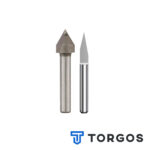
V-Groove Engraving Bits for CNC Router — 30°, 45°, 60°, 90°, 120° Price range: 7,57 € through 16,00 € (inc VAT)
Roughing Ball End Mills for CNC Wood and Metal
63,00 € (inc VAT)
Roughing ball end mills combine a serrated cutting edge with a ball nose tip for fast stock removal on CNC routers and mills. They suit wood, plastic, and metal roughing before a finishing pass, with sizes selectable from the diameter, flute length, and shank menu.
Περιγραφή
Roughing ball end mills are cutting tools built for fast, heavy stock removal while keeping the rounded ball nose profile needed for 3D contours. A serrated, wave-shaped edge lets the tool clear material quickly without losing the ability to shape smooth curved surfaces.
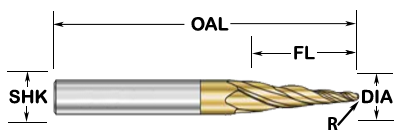
This range suits machinists and workshops running CNC routers or CNC mills who need to clear large volumes of wood, plastic, or metal before a finishing pass. Picking a size from the menu shows its diameter, flute length, overall length, shank size, and SKU.
| Description | 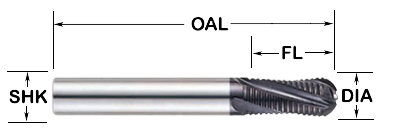 |
| Dia | 10mm |
| OAL | 100mm |
| FL | 25mm |
| SHK | 10mm |
Features of roughing ball end mills
The serrated cutting edge is the defining feature: instead of one continuous curve, the flute breaks chips into small pieces rather than long ribbons. This lowers heat and load on the tool, which is what allows roughing ball end mills to run at higher feed rates than a plain ball nose end mill.
Because chip evacuation is easier, these cutters resist chatter better on deep or aggressive passes, and the ball nose tip stays usable for 3D roughing toolpaths later finished with a smooth ball end mill. Key specifications to check:
- Cutting diameter (Dia)
- Overall length (OAL)
- Flute length (FL)
- Shank diameter (SHK)
- Number of flutes
- Coating, where applicable
Where roughing ball end mills are used
These cutters are common on CNC routers cutting hardwood, plywood, and dense foam for furniture parts, molds, and signage blanks, clearing large amounts of material before detail work starts. On metalworking CNC mills, roughing ball end mills clear aluminum and mild steel pockets ahead of a finishing tool, cutting cycle times on deep or curved cavities.
They also suit mold and pattern making, where a rough 3D shape is cut first with roughing ball end mills and then refined with a standard ball nose end mill. Browse the full CNC parts range at the torgoscnc.gr shop for compatible collets and holders.
What to check before buying
Match the shank diameter to the collet fitted on the spindle; a mismatch is the most common reason a new cutter cannot be used straight away. Check the flute length against the depth of the pocket, since a flute that is too short will not reach the bottom of the cut.
Confirm the material roughing ball end mills are rated for; a cutter built for wood and plastic will not hold up in steel. Also check flute count: fewer flutes clear chips faster in wood and aluminum, while more flutes suit harder metals at lower feed rates.
Installation and maintenance
Fit the shank fully into the collet before locking it, keeping overhang close to the flute length, since extra stick-out increases vibration and shortens tool life. Run new roughing ball end mills at a conservative feed rate first to check for chatter before committing to full-speed roughing. See the Wikipedia entry on milling cutters for background on the geometry.
Clear resin, aluminum, or steel chips from the flutes after each session, since packed chips trap heat and dull the edge faster than normal wear. Inspect the cutting edges for chipping, and replace the tool once the serrations round over and stop breaking chips cleanly.
FAQ
What makes roughing ball end mills different from a standard ball end mill? The serrated edge breaks chips into smaller pieces, allowing faster removal with less heat, while the ball nose stays usable for later finishing.
Can roughing ball end mills be used on both wood and metal? Yes, provided the specific size is rated for that material; flute count and coating differ between the wood and metal versions.
Do roughing ball end mills leave a rough surface? Yes, they are meant for stock removal, not final finish, so a smooth ball end mill should follow.
Επιπλέον Πληροφορίες
| Flutes | 4 Flute |
|---|---|
| Drill diameter | 10mm |
Reviews (0)
Shipping & Delivery


Αποστολή & Παράδοση
Όλες οι παραγγελίες αποστέλλονται με ACS Courier και παραδίδονται σε 1-3 εργάσιμες ημέρες.
Κόστος αποστολής:
- Αποστολή: €5,80
- Αντικαταβολή: €5,50
- Δωρεάν αποστολή για παραγγελίες άνω των €100
Ογκώδη δέματα:
Για ογκώδη ή βαριά δέματα η αποστολή πραγματοποιείται μέσω μεταφορικής εταιρείας με χρέωση στον παραλήπτη.
Αποστολές εκτός Ελλάδας:
Πραγματοποιούνται κατόπιν συνεννόησης. Επικοινωνήστε μαζί μας για περισσότερες πληροφορίες.
Related products



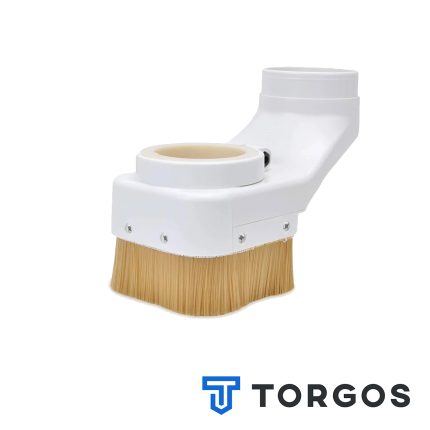
Dust Shoe for Water-Cooled CNC Spindles — Ø80 & Ø100mm
This dust shoe fits around a water-cooled CNC spindle, enclosing the spindle body and its cooling tubes without restricting movement. Perimeter brushes seal against the workpiece while a side port connects to a shop vacuum or central dust extraction line. It keeps the work area visible and free of chips during wood, MDF, and plastic routing.



Reviews
There are no reviews yet.